Redemption through love and kindness
Last ChristmasRedemption through love and kindness is the gradual transformation of Caleb (Malphas) from a being who sees himself as a demon and answers injury with killing into someone who can build with his hands, protect human lives, and feel the pain of their loss. Lilliana begins that change by seeing a faithful, fearless warrior where Caleb sees only a monster; the life he shares with her gives that recognition practical form. His redemption is not a clean escape from violence: when love makes him care, grief can hurt more than numbness ever did.
Recognition and the first change
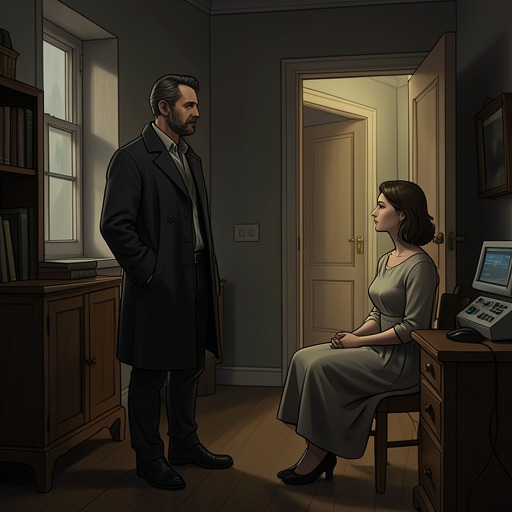
Caleb’s transformation begins with Lilliana’s refusal to define him by what he is or has done. Looking at his wounds and scars, she reads courage and faithfulness in them and gives him the name Caleb, imagining him as a noble warrior who defends what he believes. She even predicts that one day he will be able to see that man himself. The act matters because Caleb has been forsaken into a harsh world without friend or family; Lilliana offers him not absolution for a catalog of deeds, but a different understanding of what his strength might mean.
Her words break through the emotional barrier he has carried since that abandonment. Caleb answers with horror at the thought of seeing a man in a mirror, imagining that he would scream and kill it. The grim joke does not erase his self-loathing; it makes its depth visible. Lilliana responds as though the future she has described is still possible, then turns to the concrete work of retrieving his sword and supplying him until he can rejoin his army. Her kindness therefore joins affirmation to care for his immediate safety, rather than leaving redemption as an abstract promise.
Creation instead of destruction
During the more than two months Caleb stays with Lilliana and her father, his change becomes visible in the barn. He works on its roof and goes beyond the expected repairs, making an addition that serves as his bedroom. The building improves through sustained labor, not a display of supernatural power: Caleb does not use his powers for the work and discovers that he likes making things with his hands.
That choice marks a sharp contrast with the identity he has brought into the household. Caleb explains that he has never made anything before, apart from corpses. He takes satisfaction in creating, and his distinction between creation and destruction gives the barn’s repair a wider significance: what matters is not simply that he can exert power, but what he chooses to do with it. Lilliana welcomes his teasing honesty while recognizing how painful the past behind it is. She also sees that killing is no longer his automatic answer to every grievance. Love does not erase that history, but it begins to alter his habits.
Human lives, allegiance, and the cost of care
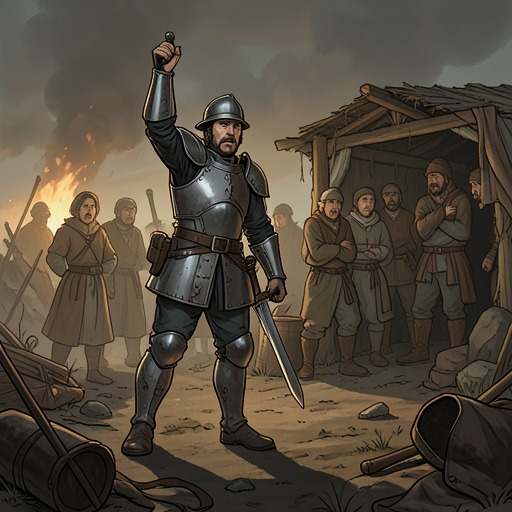
Caleb’s growing attachment to people becomes a test of his identity in battle. When he joins the fray, the Sephirii attack him. He is unwilling to harm them, so he takes their blows while trying to reach his own side. The episode turns his change into a bodily conflict: neither his former allegiance nor the new people he is trying to defend can be reconciled without suffering. Later, he returns to the battle with allies, and they eventually rout the demons. Itzal survives, leaving Caleb aware that he may tell Azura of his defection; the protection of the humans has carried a consequence within the world he is leaving behind.
After the fighting, Caleb is bloody amid the bodies, and the people he has helped are safe. What has changed most is his response to the dead. He knows many of them; he has laughed with them and celebrated solstice and other holidays with their families. For the first time, their deaths cause him searing pain. He recognizes that Lilliana has made a demon care about human lives, then recoils from what that care costs: he misses being numb to death and even the old wish for death in battle, which at least promised an escape from feeling nothing.
Xevikan gives Caleb’s altered loyalties a blunt name by asking whether the humans are still his kind and suggesting that he has upgraded. Caleb wants to argue, but accepts the point: living with his wife has taught him that people have hearts, rather than being the insignificant animals he once imagined. He considers himself fortunate to have found Lilliana and that she loves him in return. The exchange makes belonging a question of recognition and attachment, not simply origin. Yet the battle shows that this recognition cannot shield him from the cost of choosing whom to protect.
Love, grief, and the unfinished redemption
When Lilliana dies, Caleb gathers her body into his arms, falls to his knees, and sobs. His response is not the old numbness he once longed for but the anguish of a person whose attachment has remade his sense of what can be lost. He immediately vows to bring hell down on everyone responsible, to spare no one, and to pursue them even if it takes a million lifetimes. The vow exposes the danger within his transformation: the capacity to love has made him capable of grief, but grief threatens to redirect his strength toward vengeance.
Later, Caleb recalls love as both his greatest treasure and his greatest pain. The absence of it burns in his soul, nothing soothes the wound, and reminders return him to the scale of what he has lost. Redemption through love and kindness is therefore neither a simple conversion nor a cure for violence. Lilliana’s recognition teaches Caleb to create and to regard human beings as people with hearts; his care for them makes their deaths matter. Her loss does not undo those changes, but it leaves their continuation under pressure, as love’s power to make life meaningful is bound to its power to make absence hurt.